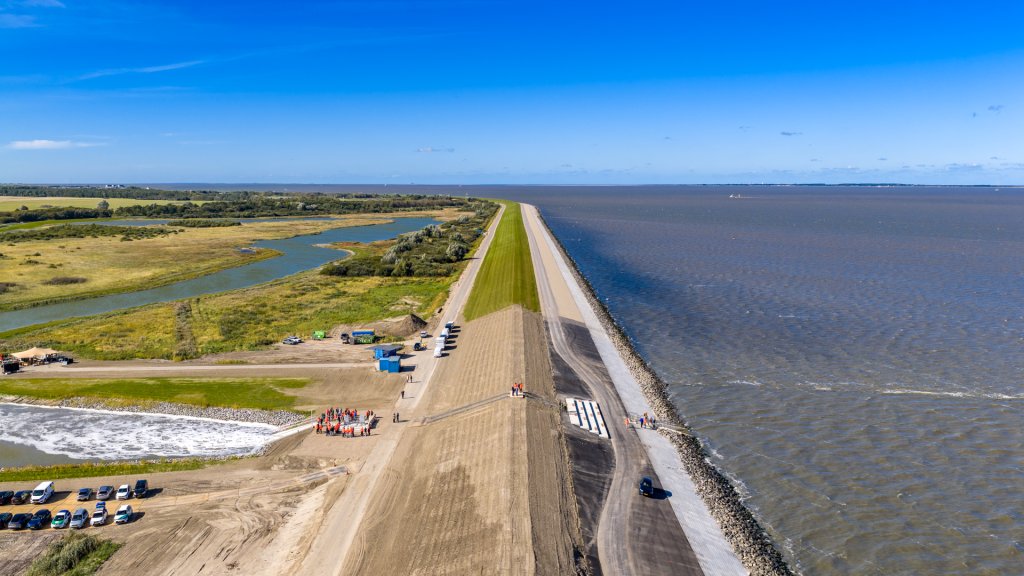
Lauwersoog dyke passage opened: new tidal area in De Marnewaard
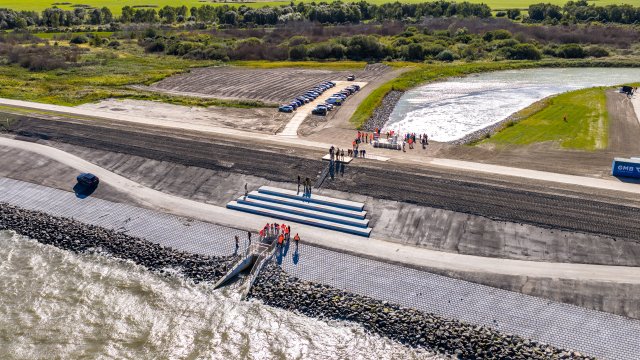
On 25 September, the dyke passage in the Lauwersmeer dyke was opened officially. The culvert in the sea defence connects the Wadden Sea with a new 70-hectare tidal area inside the dyke in the Marnewaard. The area will have a tidal range of 20 centimetres. This will enhance the habitat for plants and animals.
Dyke reinforcement and nature go hand in hand
The Lauwersmeer dyke will be reinforced until 2026, so that it can protect us for the next 50 years against higher sea levels and extreme weather as a result of climate change. The dyke reinforcement is part of the national Flood Protection Programme (HWBP).
The reinforcement of the Lauwersmeer dyke will be accompanied by three ecological projects that together will increase the resilience of the Wadden Sea region. In addition to the tidal culvert and the Marnewaard tidal area, these projects include the construction of artificial reefs and tidal pools at the foot of the dyke and the natural development of salt marshes near the Westpolder. These nature measures are part of the national Programmatic Approach to Large Water Bodies (PAGW) programme.
The dyke reinforcement not only ensures water safety but also contributes to richer biodiversity along the Wadden Sea coast. By softening the hard transition between the mudflats and the dyke, more suitable habitats for shellfish and molluscs are created. Birds, fish, and other aquatic life will gain a more food-rich area.
Initiators on the realisation of the tidal area
Leo Wenneger, provincial executive of the Province of Groningen: “Thanks to the tidal culvert , 70 hectares of land inside the dykes in the Marnewaard are once again subject to the influence of the tides. This is unique in its design and scope, as it creates a richer habitat for countless plant and animal species from the Wadden Sea. It clearly demonstrates how we in Groningen are working to create a coastal zone that is in harmony with the dynamics of the Wadden Sea region. The ultimate goal is a broader coastal zone that is ready for the future (water safety) and offers space for unique nature, agriculture, recreation, and quality of life.”
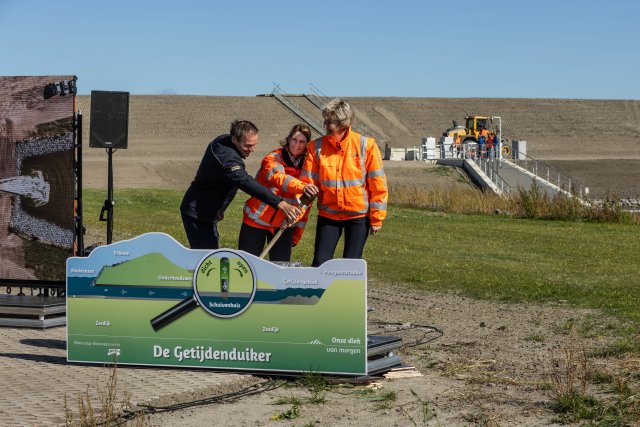
Annette van Velde, board member of Noorderzijlvest Water Authority: “It’s wonderful that we can use the dyke reinforcement necessary for flood protection to also strengthen nature. Together with market players, we are building the most sustainable dyke in the Netherlands, with significantly lower emissions and the smart use and reuse of raw materials. It’s great that we can also incorporate ecological projects into this effort. A tidal culvert may sound like a hole in the dyke, but it is actually a well-thought-out and safe structure designed to allow water to pass through in a controlled manner—without compromising water safety.”
Mieke Langedijk, Director of Rijkswaterstaat Northern Netherlands: “At the boundary between the Wadden Sea and lake Lauwersmeer, we are combining protection against the water with space for nature development. Together with all stakeholders, we have invested in measures that help improve the ecological water quality of the Wadden Sea. The arrival of the tidal culvert is of great importance in this regard. As is the construction of artificial reefs and tidal pools at the foot of the dyke, and the salt marsh expansion near the Westpolder. With these measures, we are making the transition between the mudflats and dyke more natural. This is good for birds, fish, and underwater nature.”
Tidal area in the Marnewaard
The tidal culvert unlocks the new 70-hectare tidal area in De Marnewaard behind the Lauwersmeer dyke. With the opening of the culvert and the subsequent influx of seawater, a tidal area will be created. This will increase biodiversity and improve water quality. New habitats are expected to emerge for species such as samphire, sticklebacks, smelt, avocets, and spoonbills.
The culvert in the sea dyke of approximately 80 metres long and 2 metres wide, allows seawater to flow in and out of the tidal area in a controlled manner and within water level regulation limits. For water safety, the tidal culvert has two sluice gates that can close the passage. This allows us to determine the water level in the tidal area. The location of the new tidal area is the old salt marsh area of the Marnewaard military training ground. This part of the site is not used for military activities.
Cooperation and financing
The nature projects are an initiative of the Groningen provincial executive, Noorderzijlvest Water Authority, Rijkswaterstaat, together with the Groninger Landschap Foundation (acting on behalf of the nature organisations Natuurmonumenten (Dutch Society for Nature Conservation), Staatsbosbeheer (Dutch Forestry Commission), and the Groningen Nature and Environment Federation). The total cost of the projects amounts to 32 million euros. This amount is funded by the Programmatic Approach to Large Water Bodies (PAGW) of the Ministries of Infrastructure and Water Management (I&W) and Agriculture, Nature and Food Quality (LVVN), the Wadden Fund, the Province of Groningen, and funds from the NextGenerationEU programme.
More information
Would you like to know more about nature projects, dyke reinforcement, or a tidal culvert? Read more on the websites below.
- Nature projects: https://lauwersmeerdijk.noorderzijlvest.nl/natuurprojecten
- Lauwersmeer Dyke-Vierhuizergat dyke reinforcement: https://lauwersmeerdijk.noorderzijlvest.nl/
- Tidal culvert: https://lauwersmeerdijk.noorderzijlvest.nl/online-serie-de-bouw-van-de-getijdenduiker