Dyke Reeve: "Living safely with water is becoming less self-evident"
On October 9, the KNMI presented the new climate scenarios for the Netherlands. The conclusion: temperatures will rise in all seasons. We will face extreme precipitation and drought even more frequently. Weather extremes will follow one another more rapidly. In addition, sea levels will rise faster than previously thought; we may metre a sea level rise of 1 metre the year 2100. This has major consequences for water management.
KNMI climate scenarios
According to the KNMI, periods of flooding and prolonged drought are on the rise. The ability to ensure a sufficient supply of fresh water when conditions are too dry and to drain excess water when conditions are too wet is coming under increasing pressure. “Living safely with water is no longer as straightforward as it used to be,” says dyke reeve van der Schaaf of Noorderzijlvest Water Authority.
New forms of coastal protection
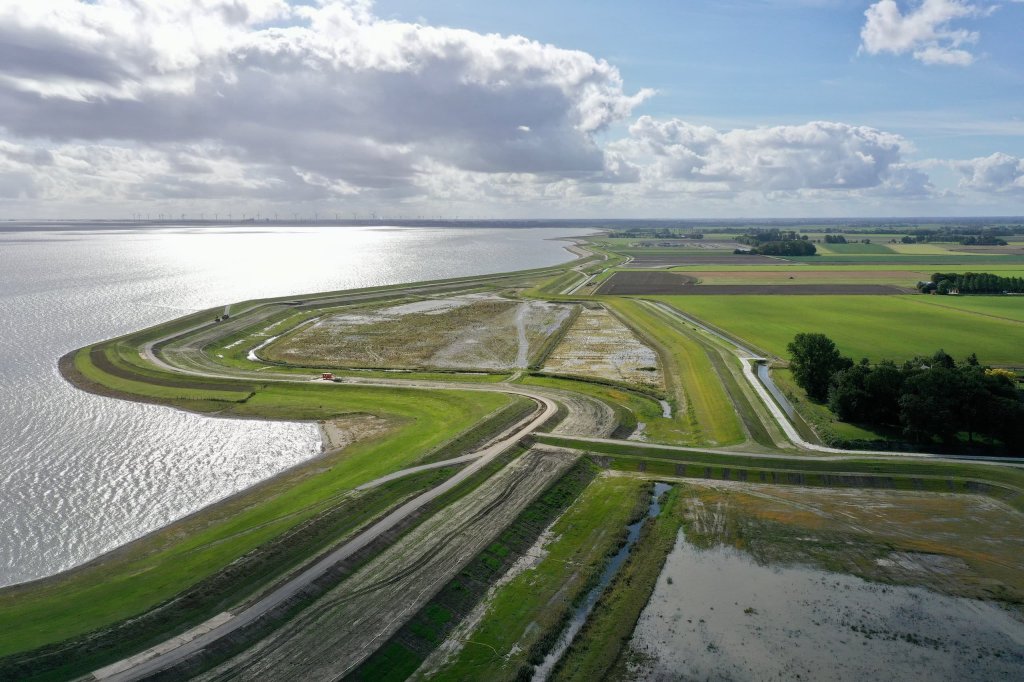
The water boards use the climate scenarios to establish standards for water safety, flooding, and drought. In its response to the climate scenarios, the Dutch Water Authorities the urgency of continuing dykes reinforce dykes and setting aside sufficient space and funding for this purpose. The dyke reeve : “Reinforcement operations are taking place throughout the country; this is the largest undertaking since the Delta Works. We must certainly carry out those plans. In our area, the sea dyke is currently sea dyke along the Lauwersmeer-Vierhuizergat section.” The dyke reeve that in the near future, more will be needed than simply continuing to raise and widen the dykes. “Of course, that can’t go on indefinitely. There won’t be enough space for that everywhere. That’s why investigations are already underway across the country—and certainly in our region—into how coastal defense can be designed differently: with dyke landscapes in a broad coastal zone where, for example, the vigour the sea is absorbed outside the dykes. Or where, in some places, we actually need to move more in tandem with the sea.”
The year 2100 is the new starting point
The water authority an institution has existed for centuries and ensures that we can continue to live in the delta. “We’ve already done a lot to dykes the dykes , temporarily store excess water, and subsidence problems caused by subsidence . We’ll keep doing that. But with an even more threatening outlook,” says the dyke reeve. According to Van der Schaaf, it is absolutely necessary that we base our planning on the 2100 scenario outlined by the KNMI: “If we all think now about what will be needed by that time to live here safely with water, we’ll have a better idea of what decisions we need to make right now.” The dyke reeve it dyke reeve very wise to already take into account a different spatial plan for a broad, safe coastal zone. “This requires a planning reservation and robust consultation and coordination with the national government, the province, and councils, councilsadds Van der Schaaf.
Important for safety in the region: discharge into the sea
For the northern Netherlands, the latest climate scenarios underscore the need to continue draining excess precipitation into the sea. Currently, this is largely achieved by gravity flow from the high sandy soils in Drenthe through the lower-lying catchwater Groningen, via Lauwersmeer and the Clevering locks, to the Wadden Sea. If sea levels rise by one metre , drainage by natural flow metre virtually impossible.
“To ensure water safety in our region, the realisation one or more large sea pumping stations is unavoidable. This means we are facing some very substantial investments. The northern water boards certainly cannot shoulder these enormous investments on their own,” says the dyke reeve.
Working together to evaluate land-use changes
The days when technology solved everything are over. Van der Schaaf:
“We need to rely more on natural values in our water system; we should fight against water less and go with the flow more. Technology will continue to help us manage water. But completely eliminating risks is truly a thing of the past. We must learn to accept droughts and flooding to a certain extent and work together to determine what function the available space will serve and what adjustments to land use are desirable. From now on, land use will have to customise more and more to water, the soil, and the effects of climate change. This applies to all types of land use, such as development, agriculture, and nature.”
Space must be reserved at all levels
To keep our landscape and water systems climate-resilient, we therefore need more space and significantly more funding for adjustments to water management. That is why the water boards are advocating for these spatial reserves for water to be included in, among other things, the Spatial Planning Policy Document currently being drafted by the Ministry of the Interior. Noorderzijlvest dyke reeve through its dyke reeve : “These spatial reservations must also be incorporated into provincial and municipal environmental visions and associated regulations. That, too, must happen now so as not to waste any time!”
Finally, the water boards are calling for a substantial increase in the Delta Fund’s financial resources so that our country will be better prepared to cope with the uncertainties posed by rising sea levels.