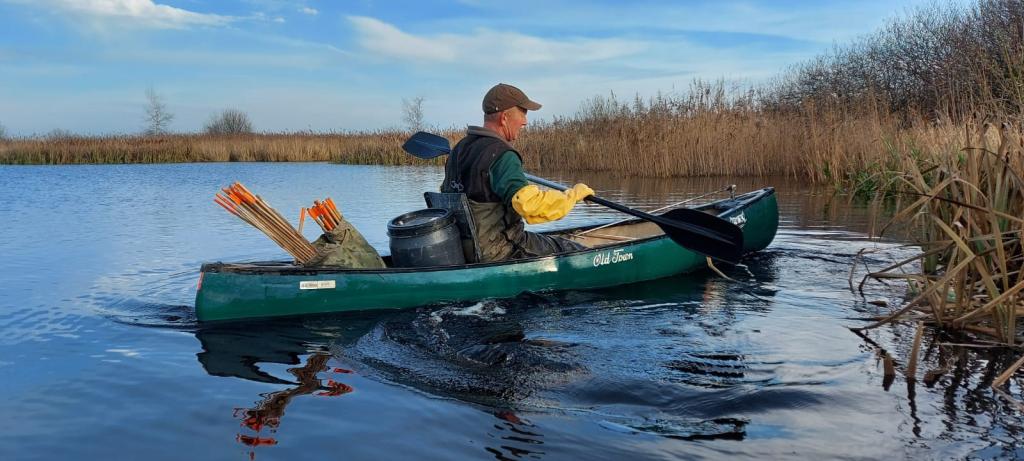
Northern water authorities extend cooperation on muskrat and coypu control
The Noorderzijlvest, Hunze en Aa’s, Drents Overijsselse Delta, and Vechtstromen water authorities are extending their cooperation in the fight against muskrats and coypu. To this end, they signed the ‘Cooperation Agreement on Muskrats and Coypu Control between the Drenthe, Groningen, and Overijssel’ water authorities.
Collaboration
The participating water authorities are satisfied with the collaboration. Coordination takes place at an administrative level, experience and knowledge are exchanged, and joint search operations are organised. The common goal is to reduce the population of muskrats and coypu. And that has been successful, as figures from recent years show. The previous agreement expired in 2022. The new period runs until 1 January 2033.
Damage to dykes
Muskrats and coypu are not native to the Netherlands; they have been introduced here by humans. These animals also have few natural predators in our country. They are controlled because they cause damage to dykes, flood embankments, and riverbanks by digging burrows and tunnels. They also build nesting chambers with extensive underground tunnel systems.
Threat to biodiversity
Muskrats and coypu also pose a threat to biodiversity. Therefore, both animals are included on the European list of invasive species. They eat plants such as reeds and cattails, displacing native species such as the black tern, the bittern, and the reed warbler. These birds live in the reeds, which are also the habitat of muskrats and coypu.
Push back to national border
The control of muskrats and coypu is regulated by law in our country. The aim is to keep the population as small as possible so that damage can be managed. The ultimate goal is to push back the muskrat and coypu populations to the national border. The aim is that there will be no viable population left in the interior of the Netherlands by 2034.
More information
Water authorities combat muskrats and coypu. They do not fit into our water system.