
Maintenance of bank-protection structures
In the Noorderzijlvest Water Authority region there are miles of sheet piling, quay walls, and sheet pile walls designed to protect banks. On this page, we explain who is responsible for maintaining these bank-protection structures along main watercourses.
Basic rule
The basic rule is that the party that needs the bank-protection structure is also responsible for the maintenance. This may be the water authority, the owner of the land along the watercourse, or both. When we determine who needs the bank-protection structure, it does not matter who owns the land on which it is built.
Who needs the bank-protection structure?
The water authority needs protection from a bank-protection structure if:
- The dimensions of the watercourse (depth and width) are too narrow for the volume of water it needs to carry.
- The bank-protection structure is part of a flood defence (dyke) that must be protected to prevent flooding.
- There is a mowing path owned by the water authority between the watercourse and the adjacent plot. We use this path when we maintain the watercourse.
For the owner of a plot, bank-protection structure may be important for protecting a garden, house, or another property, such as a jetty for example.
Examples
1. The water authority is responsible for maintenance
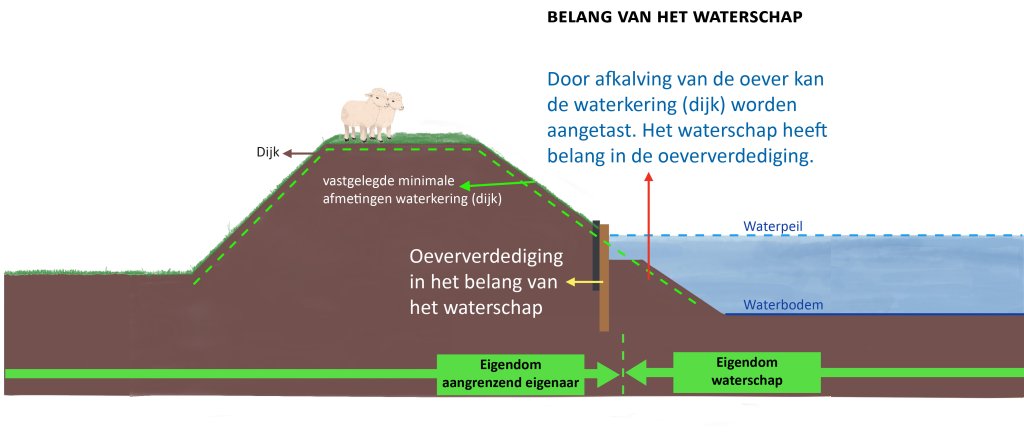
The image titled "Interest of the water authority' shows that the water authority needs the bank-protection structure. It protects a dyke. This means that the water authority is responsible for its maintenance and covers the costs.
2. The adjacent owner is responsible for maintenance
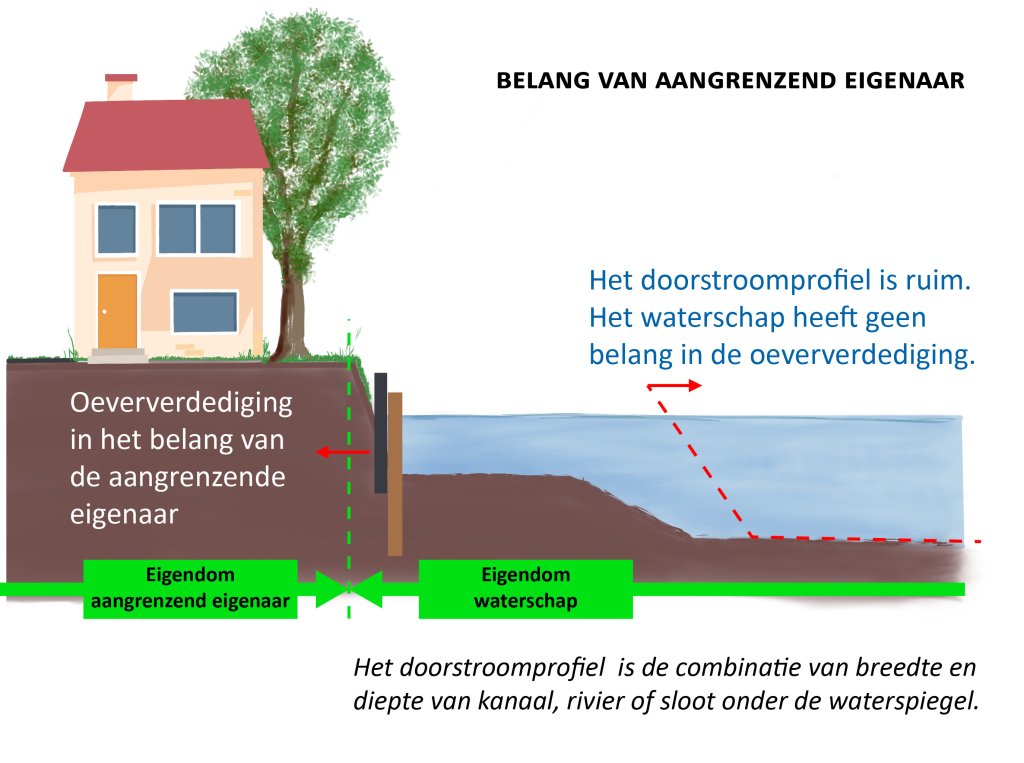
The image titled “adjacent owner” shows that the owner of the land adjacent to the watercourse needs the bank-protection structure. It protects the land on which the house is built. The watercourse is wide and deep enough to allow water to flow away properly. This means that the adjacent owner is responsible for its maintenance and the associated costs.
3. Both parties are responsible for maintenance
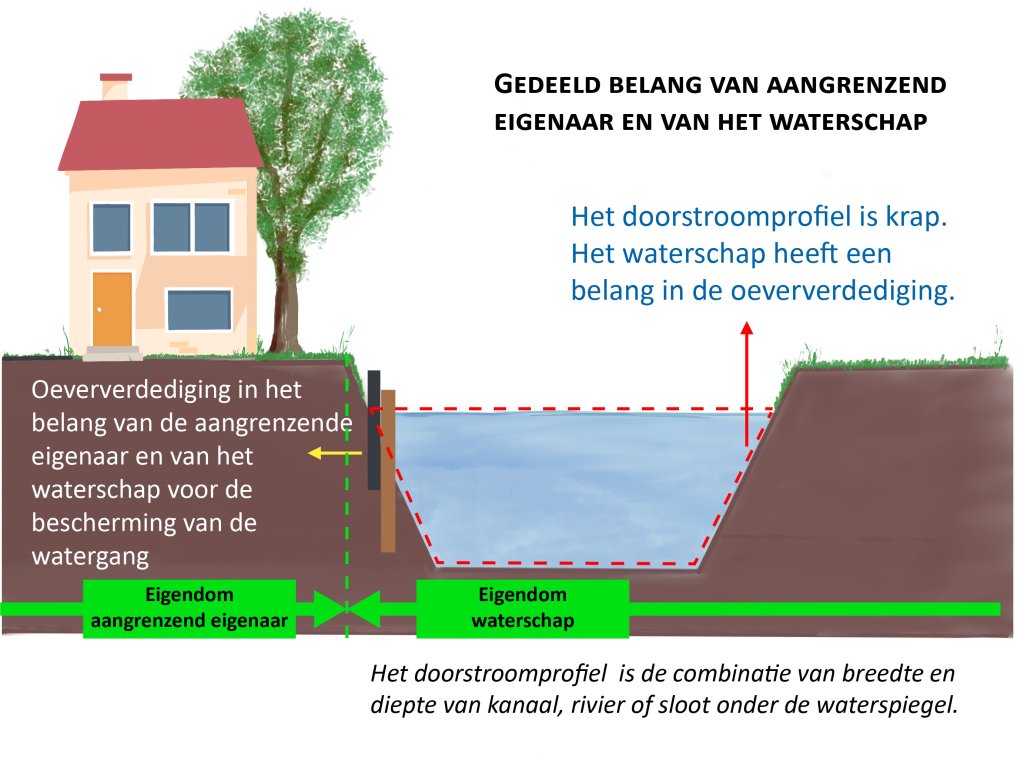
The image titled “Interest of the adjacent owner and the water authority" shows that the owner of the land adjacent to the watercourse and the water authority need the bank-protection structure. It protects the land on which the house is built and the watercourse is not wide or deep enough to allow water to drain properly. Both parties will share responsibility for maintenance.
In cases of shared responsibility, we always pay the portion required to ensure our protection. If that is also sufficient for the landowner, there are no additional costs. It is also possible that the landowner may require more extensive bank protection. In that case, the additional costs are borne by the landowner. When the time comes, we will discuss this and document the agreements we reached.
Does a bank-protection structure need to be built, modified, or replaced?
If you want to modify or replace sheet piling, a quay wall, or a retaining, you need a permit from the water authority. When we issue the permit, we determine who needs the bank-protection structure and, consequently, who will be responsible for its maintenance. We include this information in the permit.
More information
Frequently asked questions about the Bank-Protection Policy
- The maintenance register lists who is responsible for the maintenance of each watercourse, embankment, and dyke. More information about the Maintenance Register.
- A main watercourse a major channel for the inflow and outflow of water. Such a ditch, canal, or river is usually wider and deeper than other watercourses, such plot ditches. Main watercourses are part of the water authority's primary water system. They are shown on our water authority map.
Do you have questions about the regulations for the maintenance of sheet piling, quay walls, or retaining walls along main watercourses? Please email us at onderhoudoevers@noorderzijlvest.nl or write to us at: Noorderzijlvest Water Authority, Postbus 18, 9700 AA Groningen. We will get back to you as soon as possible.
Documents (Dutch only)
- Noorderzijlvest Water Authority bank protection Policy (officielebekendmakingen.nl):Waterschapsblad 2022, 8915 | Overheid.nl > Officiële bekendmakingen
- Water-authority regulation containing the articles on the bank-protection structure policy (Chapter 2 (in particular Title 2.1 and Sections 2.2.3 and 2.2.4) and Chapter 3, Section 3.2.16): https://lokaleregelgeving.overheid.nl/Waterschapsverordening Noorderzijlvest