Implementation of Lauwersmeerdijk-Vierhuizergat reinforcement project commences
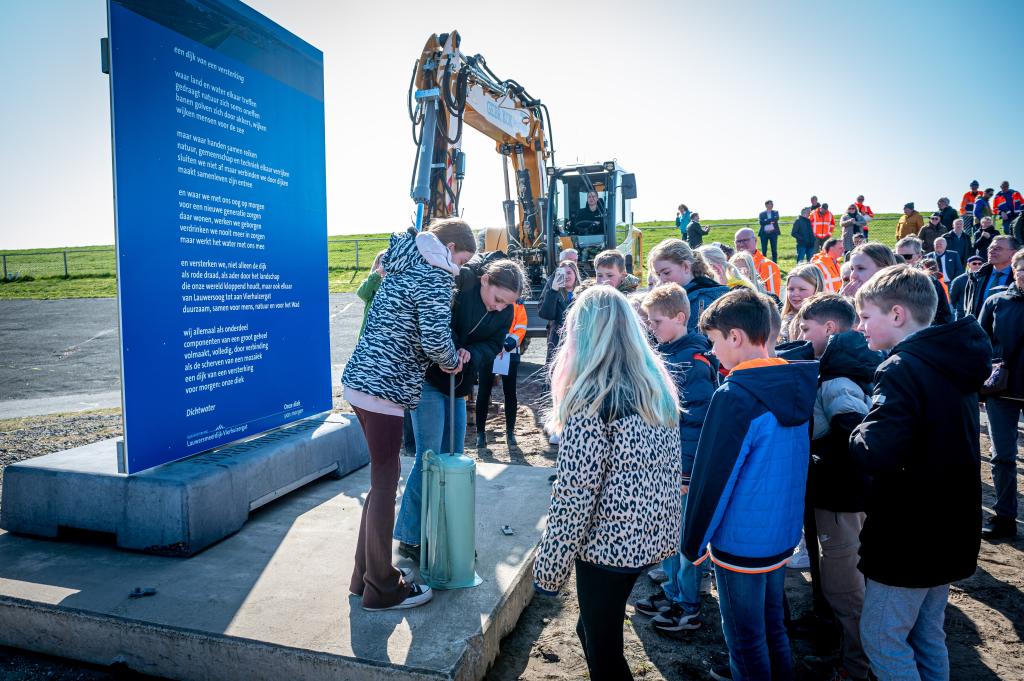
On Wednesday, April 5, the start of the Lauwersmeerdijk-Vierhuizergat dike reinforcement project was celebrated in the harbour Lauwersoog. On the sea dyke , residents, officials, and business owners sea dyke a special poem about the dike reinforcement. Following this, the 7th and 8th-grade students from the “Mandegoud” elementary school in Kloosterburen sounded the ship’s horn. With this, they gave the starting signal for reinforcing the dike of tomorrow. After the festive kickoff, young and old alike enjoyed an open house featuring information and activities.
Water safety
The reinforcement of the dyke additional measures related to nature, recreation, the economy, and traffic safety will be finalised in 2026. Reinforcement of the dyke necessary because it no longer meets water safety standards. Once the work is completed, the dyke will once again provide protection against rising sea levels and extreme weather caused by climate change dyke next 50 years.
Most sustainable dyke
In carrying out this dike reinforcement project, special attention is being paid to reusing materials and reducing emissions. For example, zero-emission electric equipment is being used, along with renewable, fossil-free HVO diesel. This will enable the water authority to reduce water authority by up to 95%. The sea dyke Westpolder and along the Vierhuizergat is being raised and reinforced with clay and stone revetment. Material from the existing dyke reused, and new material is sourced from the region. In the harbour , the dyke harbour dyke and raised with a sheet pile wall. The Waddenkwartier contractor consortium, moulded GMB and Heijmans, is carrying out the dyke reinforcement.
Dyke functions related to nature, traffic, and recreation
The dyke reinforcement project will also enhance the Wadden Sea ecosystem, dyke recreational activities around the dyke , and improve traffic safety. The latter involves the construction of a second access road to the harbour Lauwersoog. A pedestrian promenade will also be built along the harbour, along with a bike path and a viewing platform on the rural dyke the Vierhuizergat. With regard to nature, a salt marsh will moulded as a natural transition from the dyke the Wadden Sea. A dyke passage an inland tidal area of approximately 70 hectares will also be created in the Marnewaard. Furthermore, a pilot project with reef elements is underway off the coast. In this way, the measures associated with this dike reinforcement ensure a more natural transition between land, mudflats, and water. realise these additional tasks in collaboration with council , the Province of Groningen, Rijkswaterstaat (on behalf of the Programmatic Approach to Large Water Bodies), and Groninger Landschap, also on behalf of nature organizations Natuurmonumenten (Dutch Society for Nature Conservation), Staatsbosbeheer (Dutch Forestry Commission) Natuur en Milieufederatie Groningen. Eisse Luitjens, councillor with special responsibilities atNoorderzijlvest Water Authority: “The broad and enjoyable collaboration surrounding this dyke reinforcement makes me particularly proud. Together with government agencies, nature organizations, and residents, we have added benefits for nature, traffic, and recreation to a strong dyke. Together with the private sector, we are reinforcing the dyke significantly lower emissions and the smart (re)use of raw materials. In this way, we are building the most sustainable dyke the Netherlands together. I warmly invite everyone to follow and visit this project over the next four years!”
Financing
A total of €158 million has been set aside for this project. On 15 February 2023, the Board of Directors of the Noorderzijlvest Water Authority made €136 million available for the dyke reinforcement. The Flood Protection Programme contributes 90% of the costs for the water safety project. Het Hogeland council finances the second access road to the port. Funding for nature development is available from the Wadden Fund, the Programmatic Approach to Large Water Bodies (PAGW), and the Groningen provincial executive.
Why reinforce the dike?
The kilometre Lauwersmeer Dike, stretching from the R.J. Clevering Locks to the Westpolder, has protected the Lauwersmeer region and parts of the Groningen and Friesland hinterland from flooding for more than 50 years. Seawalls are assessed for water safety every twelve years. The height of the dyke the revetment on the water side no longer meet the relevant standards. Once the dyke reinforcement is complete, this section of the dyke will again meet safety requirements dyke next fifty years, providing protection against rising sea levels and extreme weather resulting from climate change. By 2050, all Dutch flood defences must flood defences the new safety standards. That is why, over the next thirty years, approximately 1,100 kilometre dyke will bedyke and 500 locks and pumping stations . We are doing this as part of the national Flood Protection Programme HWBP), which is part of the national Delta Program.
Nature Conservation in the Grote Wateren Area
Through these nature conservation measures, the dike reinforcement project contributes to achieving the statutory objectives of Natura 2000 and the Water Framework Directive. To this end, the Ministry of Infrastructure and Water Management and the Ministry of Agriculture, Nature and Food Quality have launched a separate investment program, the Programmatic Approach to Large Water Bodies PAGW). Rijkswaterstaat (RWS), the Netherlands Enterprise Agency RVO), and Staatsbosbeheer (Dutch Forestry Commission) on behalf of the PAGW with the aforementioned project partners and, in parallel with the dike reinforcement, on measures to make the Wadden Sea ecosystem more climate-resilient and robust. The primary goal is to restore the Wadden Sea ecosystem.