What happens if water becomes scarce?
In Peru, they know this better than anyone. From 27 September to 18 October, a delegation from various organisations, including Noorderzijlvest Water Authority, traveled to Piura as part of the international Blue Deal programme. The goal? To learn, together with local water partners, how Peru deals with extreme drought and water shortages. By exchanging knowledge and sharing experiences, we strengthen one another and better prepare for a future in which water will not always be a given, even in the Netherlands.
The reality of water shortages
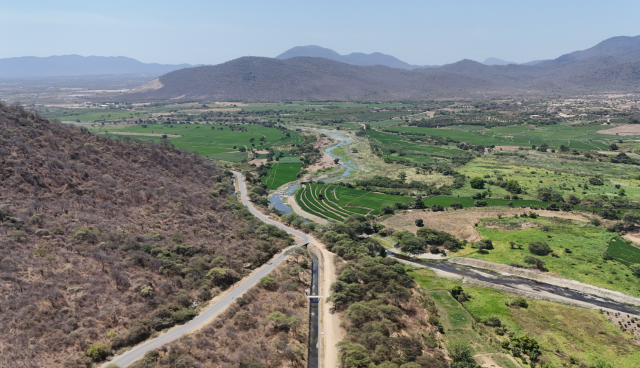
In Peru, we saw how drought is affecting the landscape: parched fields alongside narrow irrigation channels, rivers that are metres lower than normal. Scarcity forces choices – who gets water, and how do you involve society in this? This reality makes it clear why international cooperation is so important. Because here too, pressure on water is increasing. How do we ensure that we are prepared? By learning together and sharing solutions – across borders.
Learning from Piura
In Piura, drought is not a future scenario, but a daily reality. Every drop counts, which means that they are really familiar with the figures on water use and availability. In the Netherlands, water is often taken for granted, which means that awareness is less strong. That is precisely why we can learn from Peru: how do you deal with scarcity, how do you make choices, and how do you involve society in this?
A concrete example?
Researchers and farmers are working together to make irrigation smarter.
By setting up test fields and measuring exactly how much water a crop needs, farmers were able to:
- Reducing irrigation water from 17,000 to 14,000 m³ per hectare
- Increase rice yield by 12%
- Save 72 million m³ of water annually in the Chira catchment.
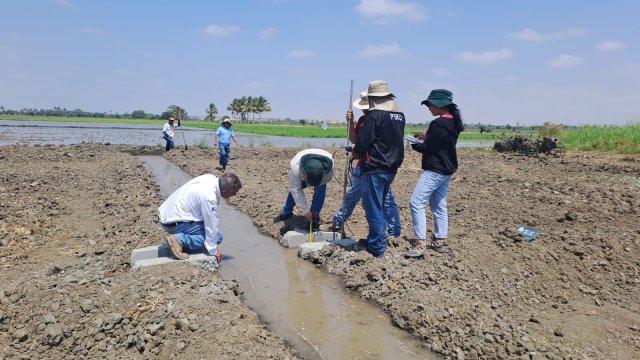
This approach—based on data, collaboration with knowledge institutions, and farmer involvement—shows how innovation and collaboration can make a difference. In Piura, graduation projects were carried out under the supervision of the National Agricultural Institute (INIA). This approach may also be relevant for the Netherlands in the future.
Why is this relevant for the Netherlands?
Here too, we see that drought causes tensions. Consider the distribution of water from lake IJsselmeer. In Peru, we saw how acute such a situation can become: last year, extreme drought led to an emergency. Water operators were insufficiently prepared, Lima had to intervene and temporarily allow groundwater use. Such situations show how important it is to be prepared and to make clear agreements. Because the KNMI (Royal Netherlands Meteorological Institute) is also warning of increasing weather extremes.
Images that speak
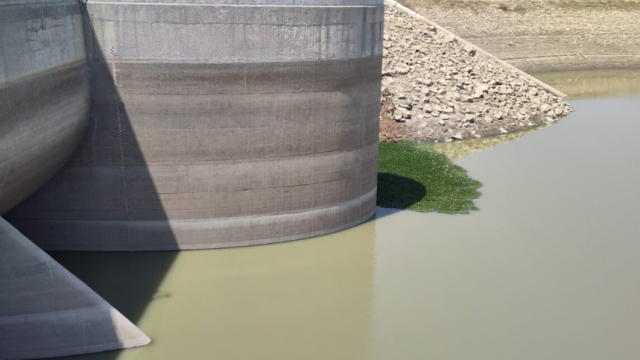
In Piura, we saw the contrast with our own eyes: the images below clearly show how great the impact is on both the landscape and society.
Learning together = being prepared together
What if the Netherlands soon has to make the same choices as Peru? Who will get water when it becomes scarce—agriculture, nature, or drinking water? Thanks to the Blue Deal Peru project, we can exchange knowledge and strengthen each other. It is important that we do not adopt these lessons one-to-one, but place them in our own context. The scale, the system, and the culture are different. It is precisely because of these differences that we learn how to make our own water management future-proof. Because only together can we ensure that we are prepared, so that emergencies do not take us by surprise.
Partnership across borders
Noorderzijlvest Water Authority the lead partner in this partnership, together with the Peruvian water authority and the Dutch water authorities: Rivierenland, Hunze en Aa’s, HHNK, Wetterskip Fryslân, and Scheldestromen, with support from DWA, Dutch Water Authorities, and the Blue Deal programme.
Read more about international cooperation