Cycling water authority employees cycle 375 km across the NAP zero metre line
On June 20, more than 1,200 cyclists will take part in the ClimateClassic: a bike ride from Breda to Groningen aimed at raising awareness about the consequences of climate change and how to prevent it. Together, they will form a colorful ribbon winding its way across the Netherlands’ NAP zero-meter line, a distance of 375 kilometre.
Relay race at every water district boundary
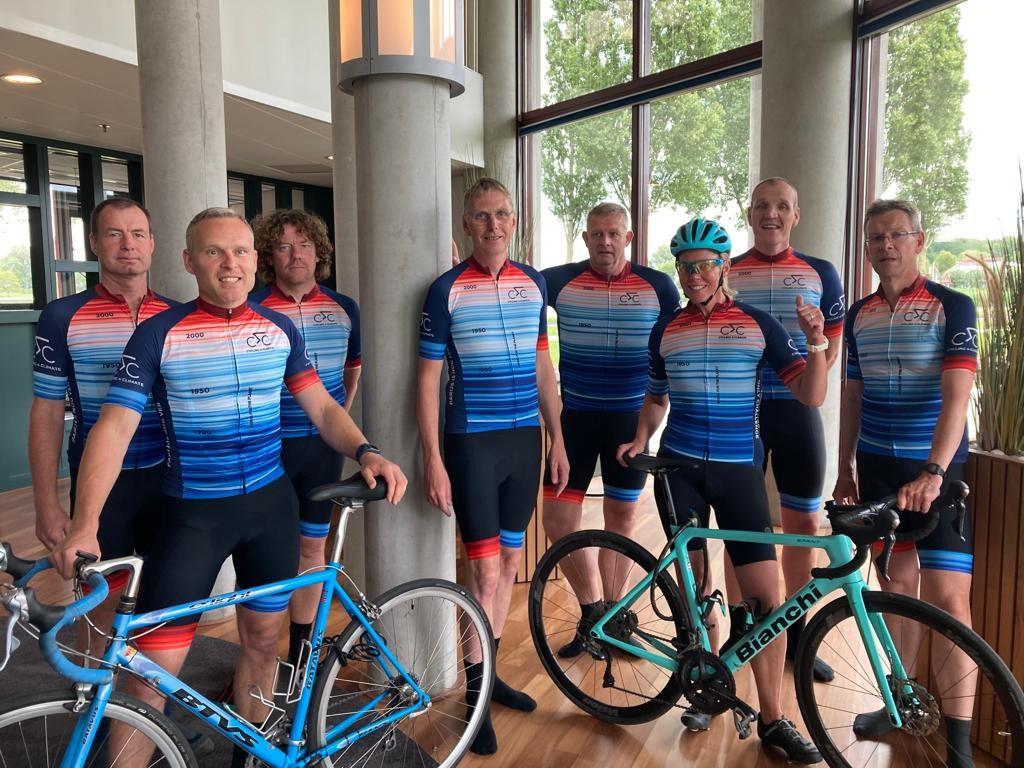
The water boards along the route are participating with nine water board relay teams, consisting of nearly seventy employees and board members. At each water board boundary, they pass the baton—a water bottle containing their climate pledges—to the next team.
The Noorderzijlvest team
Noorderzijlvest Water Authority with a team of eleven people, including board member Jeroen Niezen. At around 8:30 p.m., this team will take over the baton from the cyclists of Wetterskip Fryslân near Veenhuizen. They will then cycle the final stage—about 32 kilometre—of the ClimateClassic. They expect to finish between 9:30 p.m. and 10:00 p.m. The finish line and the end point of the ClimateClassic is at the Sugar Factory in Groningen (Stadslab, Energieweg, 9743 AN Groningen).
The ClimateClassic is an initiative of Cycling4Climate
Cycling4Climate organises with the aim of raising awareness about the climate crisis and encouraging people to get active in a fun way. Els Otterman, a member of the executive board of the De Stichtse Rijnlanden Water Board, took the initiative to have the water boards participate along the route: “As water boards, we already deal with the consequences of climate change every day. Think of periods of prolonged drought and extreme downpours. These will only occur more frequently in the future. This has major consequences for our cities and towns, our dykes our rural areas.
“Every shovel in the ground must be climate-proof,” our Delta Commissioner said recently. However, responding to the consequences of climate change is not enough. We must all work together to reduce CO2 emissions as well. As water authorities, we invest millions of euros every year in major projects such as dyke reinforcements, and in the maintenance of dykes, waterways, pumping stations, weirs, locks, and wastewater treatment plants. Thanks to this scale, we offer market players opportunities to become more sustainable and seek innovative solutions. Emission-free and circular working practices are thus becoming the new standard. Of course, this is not yet a given, which is why we are happy to use this water board relay to demonstrate how collaboration can help us make progress.”
The route the cyclists are taking wasn’t chosen at random: it largely follows the NAP zero-meter line, which—if we continue on the current path—will become the new coastline. Without the water dykes pumping stations dykes , that would already be the case today.