
Dredging watercourses
Silt is a layer of mud at the bottom of ditches, canals, and lakes. This layer of mud is created by soil runoff from the surrounding area, for example, but also by dead aquatic plants and leaves. The layer of mud grows by approximately 2.5 centimetres per year. The water authority dredges more than 2,500 kilometres of creeks, ditches, canals, and dozens of ponds.
Dredging video
Do you have land available for a pasture depot?
The water authority regularly looks for plot owners in the vicinity of watercourses scheduled for dredging who are willing to make their land available for setting up a pasture depot. The dried dredge spoil is often extremely suitable for raising the elevation and improving soil. If you have a plot available, we’d be happy to work with you to explore the possibilities for establishing a pasture depot.
More information about the how and what, the locations, and any compensation:
Why we clean up dredge spoil from time to time
There are a number of reasons why we clean up dredge spoil from time to time:
- The thicker the layer of silt, the less space there is for water. This can hinder the inflow and outflow of water. This has a negative impact on agriculture and other water-dependent sectors.
- This increases the risk of flooding. Boats also have less space to navigate.
- All kinds of substances remain trapped in dredge spoil. Sometimes, they include substances that are harmful to water quality.
- Silt contains plant debris that is decomposing. This process consumes a lot of oxygen. As a result, living plants and fish have less oxygen available.
How do we dredge?
The vast majority of the dredge spoil is deposited on the adjacent plot with a crane. The crane is positioned on the bank next to the water. The area where the crane is positioned and the dredge spoil is deposited must be free of fruit, crops, and materials, for example. We do not dredge close to the bank of the watercourse and do not remove solid ground. This ensures that the bank remains stable.
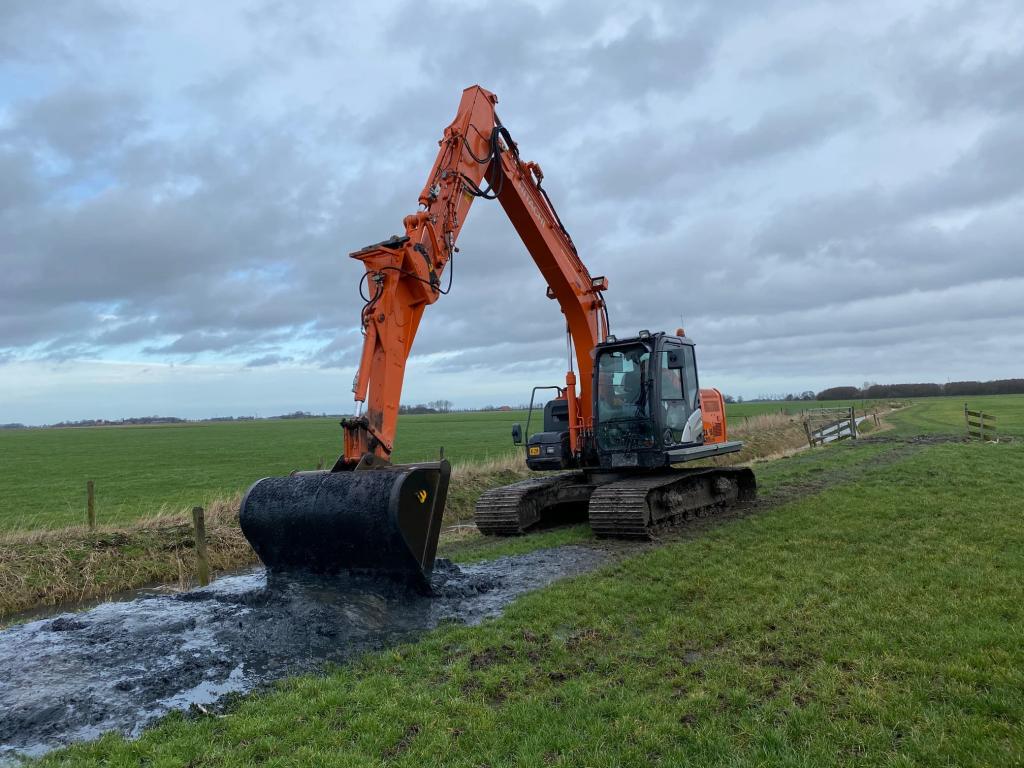
Where dredging with a crane is not possible, we use other methods. For example, we use a boat with a push blade. The dredge spoil is then pushed to a location where a crane on the bank deposits it on the plot or loads it into dumper trucks for removal. When the work is complete, we restore the site and the surrounding area to their original condition. We also flush the culverts and roads clean.
Naturally, flora and fauna are taken into account by placing flags on breeding sites and mowing in good time so that birds do not breed where dredging is to take place. This is done in consultation with a certified ecologist.
Who does what?
Who actually dredges which stretch of water? Agreements have been reached about this:
- Do you own land along a ditch? You have to make sure there is not too much silt at the bottom of the ditch. We check this every year during the so-called ditch inspection.
- The national government, the provincial executive, or the water authority make sure that dredge spoil in waterways are removed. Waterways are rivers and canals where boats are allowed to sail. Local councils dredge ponds and urban waterways.
- The water authority cleans up the dredge spoil from canals and ditches that are important to the drainage and supply of water.
Preparation and implementation of nationwide dredging 2027–2028
The watercourses Hunsingo canal, Hoornsevaart, and Molenrijgstermaar are currently dredged; this dredging job will be completed this year.
In the coming period, we will be assessing the dredging requirements for 2027 and 2028
Dredging of the following watercourses is scheduled for 2027:
- Rodervaart (hydraulic dredging contractor Verboon Maasland) pasture depot site available
- Broekstermaar (hydraulic dredging contractoVerboon Maasland) pasture depot site has not been found yet
- Oude Ae (mechanical dredging contractor Beukema) distribution to adjacent owners
- Wetsingemaar (mechanical dredging contractor Beukema) distribution to adjacent owners
- Potmaar (mechanical dredging contractor Beukema) distribution to adjacent owners
- Part of the Zuidwending near the houseboats (mechanical dredging, processing at a nearby processing site)
- Section of the Boterdiep between Bedum and Onderdendam (mechanical dredging, transport of dredge spoil to a processing site)
* Mechanical dredging with an excavator from the shore; dredge spoil on adjacent plots or transporting it to a processing site
* Hydraulic dredging with a cutter suction dredger from the water; dredge spoil at a nearby pasture depot
The dredging plan may be expanded to include additional watercourses during the preparatory phase.
What do we do with dredge spoil?
We usually determine the quality of the dredge spoil with the waterbed quality map. In specific situations, an engineering firm conducts the waterbed investigation on behalf of the water authority. More information: Use of soil, dredge spoil, and building materials
Once the quality of the dredge spoil is known, there are two things we can do with it:
- If there are harmful substances in the dredge spoil, we remove them. An example: A sewer overflow is a type of valve in the sewer system. When the sewer is too full, it discharges dirty water into ditches via this valve. The dredge spoil at this location may be contaminated and will be removed. Sometimes the dredge spoil is only slightly contaminated and can still be processed elsewhere (e.g., in a dyke).
- Does it contain any harmful substances? If not, we heap the dredge spoil on the bank along the water. This dredge spoil can be used for all sorts of things, such as filling in low spots on a plot of land, backfilling behind newly installed sheet piling, building new dams, or, in larger quantities, raising flood embankments, or widening verges.
Duty of acceptance
Owners of land adjacent to main watercourses are subject to a duty of acceptance. This means they are obliged to accept dredge spoil on their land when maintenance is carried out by the water authority. If dredge spoil is treated on your land, you will receive compensation from the water authority.
Compensation for dredging treatment
From July 2020, there will be a new compensation scheme for dredging. Landowners and users who have to treat the dredge spoil themselves are entitled to compensation. This compensation is a contribution towards the costs, based on the costs the water authority would incur for spreading the dredge spoil. An amount will be paid based on the number of cubic metres of dried dredge spoil received on the land. Owners will receive a letter from us when dredge spoil is to be accepted. The letter will always include the contact details of the water authority so it is possible to ask questions and arrange the compensation.
Treatment rates
The rates for treatment costs are indexed annually based on the Consumer Price Index.
In 2026, the water authority will pay €2.26 per m3 for 4 m3 of dried sludge per linear meter.
If the amount of dried sludge exceeds 4 m3 per linear meter, the compensation for the costs will be €3.06 per m3.
Treating the dredge spoil on the plot
Virtually all dredge spoil in our area are suitable for use on agricultural land. In some cases, it is necessary to take brown rot, PFAS, or chloride into account.
Brown rot
Brown rot survives in dredge spoil for approximately one month. Please note that the brown rot bacterium can survive longer in the bittersweet plants in the dredge spoil. Prevent the risk of contamination by spreading the dredge spoil thinly and not growing any host plants on it for one year (especially potatoes and rocket leaves).
PFAS
There are very few PFAS in the waterbed in Groningen and Drenthe. In 2019, the waterbed in the areas of Noorderzijlvest and our neighbouring Hunze en Aa’s was examined at fifty locations. That test showed that the concentration of PFAS remains well below the standards.
Chloride
In the ditches, creeks, and canals in the northern sea clay area, the dredge spoil can be salty due to salinisation. When the dredge spoil is incorporated in thin layers into or onto the topsoil or arable soil, the effects of salinisation will be limited. It is important to note that salinisation caused by spreading salty dredge spoil is only temporary, as salt is easily washed out by precipitation.
Dredging watercourses
Silt is a layer of mud at the bottom of ditches, canals, and creeks. This layer of mud is caused by soil runoff from the surrounding area, for example, but also by dead aquatic plants and leaves. The layer of mud grows by approximately 2.5 centimetres per year. The water authority dredges more than 2,500 kilometres of creeks, ditches, canals, and dozens of ponds.