
Fewer muskrats and coypu in 2021
The Noorderzijlvest, Hunze en Aa’s, Drents Overijsselse Delta, and Vechtstromen water boards caught 17% fewer muskrats in 2021 than in 2020. Total catches fell from 9,160 muskrats in 2020 to 7,591 in 2021.
This means we are getting the population under control more and more effectively. By way of comparison: ten years ago, we caught 65,009 muskrats in the northeastern Netherlands.
Inflow of coypu from Germany
The number of coypu caught also declined in 2021. In 2021, 417 coypu were caught, compared to 496 in 2020.
The Netherlands does not have its own coypu population. Over 95% of the captures take place directly along the border with Germany. Due to the mild winters of recent years, the coypu population in Germany has grown significantly, resulting in an increasing influx of coypus into the Netherlands. By capturing coypus directly along the border, we prevent them from spreading throughout the Netherlands as much as possible.
Damage to dykes
Musk rats and coypu are not native to the Netherlands. These animals have no natural predators here. Musk rats and coypu are captured because they dig tunnels and burrows in dykes riverbanks. They also build nests with extensive underground tunnel systems. This causes subsidence in dykes flood embankments. In the worst-case scenario, a dyke flood embankment could flood embankment , flooding a polder.
Push back to national border
The control of muskrats and coypu is regulated by law in our country. The goal is to keep the population as small as possible so that damage remains manageable. In 2019, the water boards decided to reduce the muskrat population, just as they have done with the coypu, to the national border. We endeavour that by 2034, there will no longer be a viable population in the interior of the Netherlands.
| Muskrat catches in 2021 compared to 2020 | Catches in 2021 | Catches in 2020 | difference (%) |
|---|---|---|---|
| Drents Overijsselse Delta Water Authority | 1.742 | 2.686 | -35% |
| Hunze & Aa’s Water Authority | 2.313 | 2.685 | -14% |
| Noorderzijlvest Water Authority | 1.292 | 1.609 | -20% |
| Vechtstromen Water Authority | 2.244 | 2.180 | 3% |
| Total for the Northeast Netherlands | 7.591 | 9.160 | -17% |
| Nutria catches in 2021 compared to 2020 | Catches in 2021 | Catches in 2020 | difference (%) |
|---|---|---|---|
| Drents Overijsselse Delta Water Authority | 7 | 18 | -61% |
| Hunze & Aa’s Water Authority | 230 | 243 | -5% |
| Vechtstromen Water Authority | 180 | 235 | -23% |
| Total Northeast | 417 | 496 | -16% |
Muskrat Management 2012–2021
Musk rats damage dykes by digging tunnels and burrows. The water authority keep the dykes and sturdy and controls the musk rat population; this is a legal obligation. We are getting the population under control more and more effectively. Because there are fewer and fewer muskrats in our area, we’re catching fewer of them each year. For example: in 2012, we caught 28,126 muskrats, and in 2021, only 1,292. And that’s good news, because the fewer muskrats there are, the less damage there is to the dykes riverbanks.
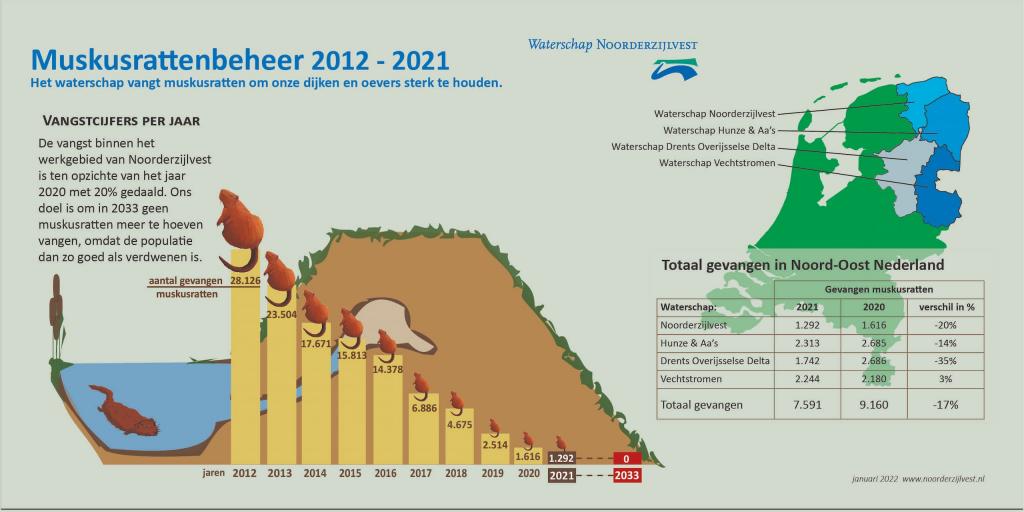
Annual catch figures
The number of muskrats caught region the region has fallen by 20 percent compared to 2020. Our goal is to no longer need to trap muskrats by 2033, as the population will have virtually disappeared by then.
Muskrat Management Through 2021
- 2012 number of muskrats caught 28,126
- 2013 number of muskrats caught 23,504
- 2014 number of muskrats caught 17,671
- 2015 number of muskrats caught 15,813
- 2016 number of muskrats caught 14,378
- 2017 number of muskrats caught 6,886
- 2018 number of muskrats caught 4,675
- 2019 number of muskrats caught 2,514
- 2020 number of muskrats caught 1,616
- 2021 number of muskrats caught 1,292