Working together towards a future-proof lake Lauwersmeer: partners emphasise urgency and shared responsibility
April 24, 2026
The Lauwersmeer region faces critical decisions. Climate change, salinization, and shifting water discharge patterns are putting both nature and agriculture under pressure. At the Lauwersmeer Administrative Summit, regional and national government officials, conservation organizations, and agricultural representatives expressed their commitment to jointly taking responsibility for a future-proof water and ecosystem.
At the invitation of the Lauwersmeer Steering Group and Noorderzijlvest Water Authority , Delta Commissioner Co Verdaas Noorderzijlvest Water Authority the Administrative Summit. He emphasized the importance of cross-border cooperation. When asked what appeals to him most about the area, he said: “We shouldn’t try to turn the tide, but rather let the tide work in our favor again. That requires us to face the facts, give each other a behind-the-scenes look, and make choices together that will still work 50 or 70 years from now.”
According to Verdaas, the Lauwersmeer region is a leader in collaboration: nature and agriculture are not at odds here, but recognize each other’s importance. “A conservationist eats a potato, and a farmer enjoys nature. We need each other desperately. Doing nothing is not an option: then both nature and agriculture will suffer.” He believes the insights from the area can be applied in other regions. The Delta Program emphasised partners must continue to have frank discussions and jointly evaluate progress annually. “If it can be done anywhere, it can be done here. Show how you’re taking steps together, even when things get rough.”
Joint conclusion
By taking action now and shaping the future, by investing in knowledge, collaboration, and clear decisions, the partners are building a region that is better equipped to cope with climate change—a region where nature, agriculture, and water management reinforce one another. In this way, the Lauwersmeer region will remain livable, resilient, and valuable for both current and future generations.
Host Roeland van der Schaaf emphasized the importance of the area: “All the water from the watersheds of both Wetterskip Fryslân and Noorderzijlvest Water Authority discharged via Lauwersmeer into the Wadden Sea. Without this drainage, water safety in the northern Netherlands would be at risk.”
A collaborative regional approach as a foundation
The consultation took place within the framework of the Lauwersmeer Future Agenda and the accompanying implementation plan. These documents outline the challenges for the next 10 to 20 years: from flood protection and freshwater availability to nature restoration, recreation, and agricultural prospects. The collaboration is administratively anchored in the Lauwersmeer Steering Group (the provinces of Groningen and Fryslân, councils Hogeland and Noardeast-Fryslân, Rijkswaterstaat Northern Netherlands, Staatsbosbeheer (Dutch Forestry Commission), Wetterskip Fryslân, and Noorderzijlvest Water Authority), the Initiative Group comprising farmers and ecologists from the area, and the PAGW Future-Proof Lauwersmeer project, part of the national Programmatic Approach to Large Water Bodies PAGW). This project explores how a robust freshwater-saltwater transition between Lauwersmeer and the Wadden Sea realised be realised .
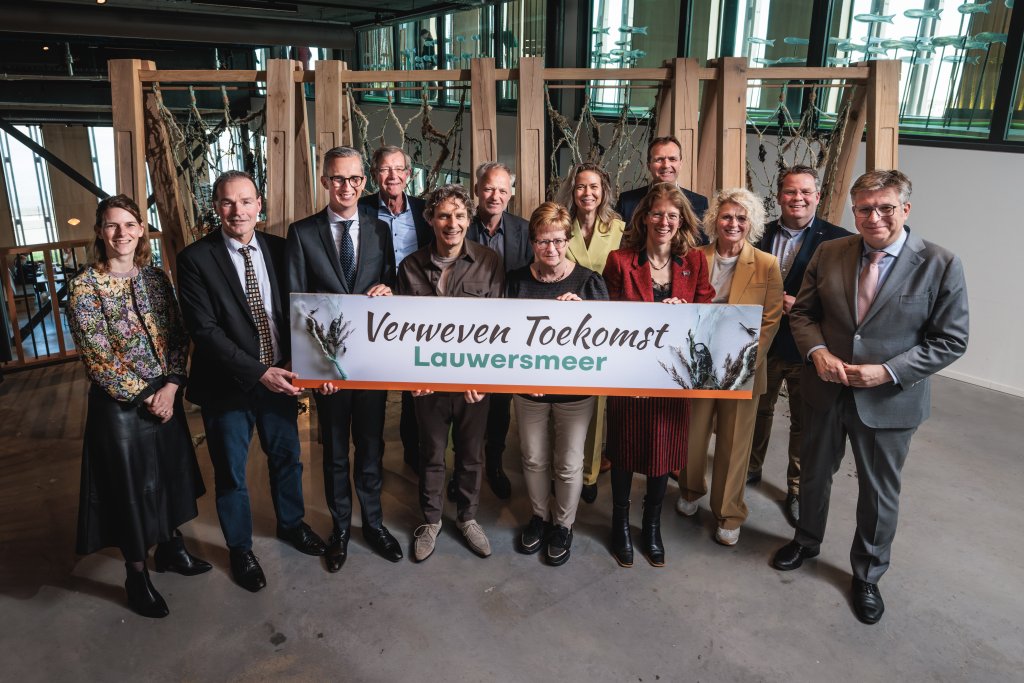
Photo by Ronnie Zeemering - From left to right in the photo:
Mieke Langedijk (Rijkswaterstaat Northern Netherlands), Leo Wenneger (Province of Groningen), Matthijs de Vries (Province of Friesland), Eisse Luitjens (Noorderzijlvest Water Authority), Donné Slangen (Ministry of Agriculture, Fisheries, Food Security, and Nature), Co Verdaas (Delta Commissioner), Maaike Prins (council ), Jorien Bakker (Natuurmonumenten (Dutch Society for Nature Conservation)), Nadja Siersema (Province of Groningen), Frank van der Werff (HZPC and AgroAgenda Noord-Nederland), Jesler Kiestra (Staatsbosbeheer (Dutch Forestry Commission)), Frank Jorna (Wetterskip Fryslân), and Roeland van der Schaaf (Noorderzijlvest Water Authority). Alderman Arjan Nolles of council Hogeland council was present at the summit but was unable to attend the photo session.
Artwork as a symbol of connexion the area
The officials pose next to Trudy Oosterhuis’s structure Future Lauwersmeer” structure . Using natural materials from Lauwersmeer, officials, residents, business owners, and visitors to Lauwersmeer are weaving together at the structure. It symbolizes the interconnectedness of people, nature, and the future, and evolves alongside the process.