Lauwersoog to get largest artificial reef along Dutch sea dyke
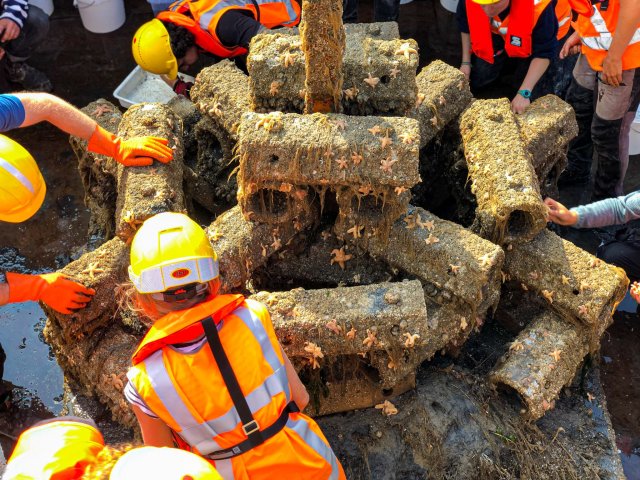
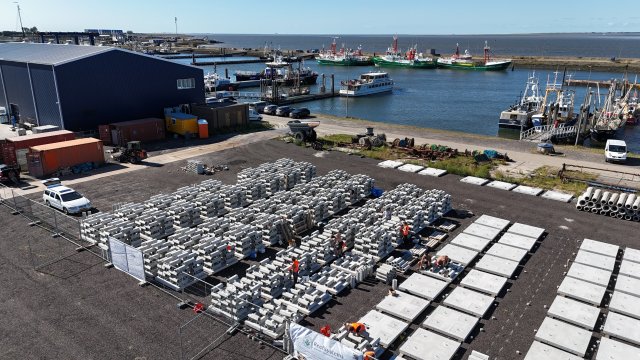
The artificial reefs and tidal pools along the Lauwersmeer dyke have proven to be a great success. Since they were first installed in 2021, there has been an explosion of underwater life. Fish, crabs, shrimp, shellfish, and algae have now established themselves in and around the structures. This autumn, Noorderzijlvest Water Authority and Rijkswaterstaat will expand the reef with 290 new reef elements and 132 tidal pools. This will give the reef a permanent home at the foot of the Lauwersmeer dyke, making it the largest artificial reef along a Dutch sea dyke.
Research confirms ecological value of reefs
Between 2021 and 2024, a study was conducted into how artificial structures can contribute to restoring the natural transition while simultaneously strengthening the dyke. Lies van Nieuwerburgh, ecologist at Rijkswaterstaat: "We see that the artificial reefs and pools are ecologically successful and form a new habitat for species. They provide shelter, resting, and spawning places for fish and other organisms. Oysters, mussels, anemones, and algae attach themselves to the structures, which increases biodiversity and creates a more robust food web and ecosystem. In this way, the reefs are a valuable addition to the underwater environment."
Space for Wadden Sea nature
The construction of dykes largely eliminated the natural transition between the mudflats and the mainland. This has had consequences for the water quality and biodiversity of the Wadden Sea. Silvia Mosterd, environmental manager at Noorderzijlvest Water Authority: “In essence, we are improving the Wadden Sea ecosystem at the boundary between dyke and sea. It’s wonderful that we can achieve such an increase in biodiversity at the foot of the Lauwersmeer dyke. In addition to the reefs, this autumn we’re also completing the creation of a tidal area in the Marnewaard and we are expanding the salt marshes along the dyke. In this way, we’re working on dyke reinforcement with the greatest possible ecological benefit.”
Cooperation and future
Van Hall Larenstein University of Applied Sciences and the University of Groningen investigated the ecological development of the reefs. The results of this research were used to design a larger reef along the new Lauwersmeer dyke, in which nature and safety go hand in hand. The project is part of the Lauwersmeer Dyke Reinforcement Project and is made possible in part by the Programmatic Approach to Large Water Bodies (PAGW) and the Wadden Fund. The reefs and pools are from ReefSystems, Econcrete, and Moreef. The Waddenkwartier consortium of GMB and Heijmans is responsible for constructing the reefs and tidal pools.
More information
Nature projects | Lauwersmeer-Vierhuizergat dyke reinforcement
(Read here about the difference between reefs and tidal pools)