Water heritage
The landscapes of Groningen, Friesland, and Drenthe tell the story of people of the northern Netherlands. This story goes back thousands of years and has shaped people, animals, and the landscape. This history is represented in our daily lives.
An important part of this story is the battle against water and the possibility of using land for living and working. The creation of terp mounds and dwelling mounds was followed by large-scale projects such as the construction of dykes, land reclamation, and water infrastructure. Over time, this became increasingly organised. From terp-mound dwellers in cooperatives to management by monks (particularly from the Aduard abbey) around 1200 to the establishment of water authorities. All these efforts constitute the historical heritage that our water authority has been dealing with on a daily basis since 2000.
Types of heritage
The most recent inventory of water heritage dates from 2019. We mainly looked at:
- Archaeological heritage
- Landscape heritage
- Built heritage
- Collections and objects
- Intangible heritage
Documents on heritage management policy
Intangible heritage was not included in the inventory. In 2020, the policy for dealing with our heritage was adopted by our Board of Directors.
If you are unable to read one of the documents for any reason, or if you have any questions about one of the documents, please send an email to info@noorderzijlvest.nl.
Current projects in which heritage plays a role
The Noorderzijlvest Water Authority has projects underway in which heritage and spatial quality play a role.
If you have any ideas about how the heritage of the Noorderzijlvest Water Authority could play a role, please share them with us!
Archives and research
We have a historical archive with 220 linear metres of documents. All of them contain information about the history of the water authority what the water authority does. The oldest documents date back to 1850. The historical archives contain a wealth of information, such as:
- Water permits
- Data on watercourses
- Minutes of board meetings
- Maps the Noorderzijlvest area
- Drawings of bridges, locks, and pumping stations
- Photos and slides of water and works
Would you like to view our archive boxes?
If you would like to take a look at these documents and the archive files, please visit the Regional Historical Centre (RHC) Groninger Archives. This is where we have stored our historical archives. The Groninger Archives are located at Cascadeplein 4 in Groningen (within walking distance of the railway station). They have generous opening hours, a large reading room, and modern scanning technologies.
The semi-static archives and objects are in our Water-authority office. If you would like to make use of them, please contact us.
Coat of arms
Every government body receives a coat of arms from the High Council of Nobility. On 15 August 1998, our water authority received the coat of arms from Queen Beatrix. The number of our coat of arms is 96.003594.
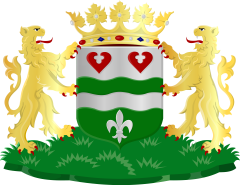
- The coat of arms is based on the coats of arms of Winsumer- and Schaphalsterzijlvest and Hunsingo. Two water lily leaves from the coat of arms of the Ommelanden have been added to the coat of arms. The water lily leaves symbolise the purity of the water.
- The lower part of the coat of arms, the lily, is the symbol of the Virgin Mary. The Marienkamp abbey, or Maria in Campis, played an important role in the history of north Drenthe. The seal image, Mary sitting on a throne, could not be combined with the other symbols in the coat of arms. Therefore, her symbol, the lily, was chosen.
- The shield bearers originate from the coat of arms of Winsumer- and Schaphalsterzijlvest and both provincial coats of arms.
Flag
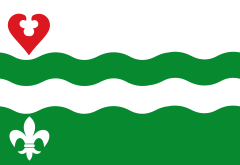
- On 5 April 2000, the Board of Directors the Noorderzijlvest Water Authority presented this water authority flag.
- The reason for this flag was the merger with the Eemszijlvest Water Authority and the transfer of the treatment task from the provincial executives to the water authority.
- The design of the flag matches the coat of arms. You can see four waves, two white and two green. Two waves are smaller. Together, they are the same size as the top or bottom wave. At the top left, you can see a water lily leaf with a white clover, and at the bottom left, a white lily.
Logo
- The logo symbolises Noorderzijlvest. The logo consists of the text Waterschap Noorderzijlvest (Noorderzijlvest Water Authority) with two areas underneath: the blue area represents the Reitdiep and the green area represents the sea dyke. Together, they form the flow of the Reitdiep through the dyke into the sea.
- The logo represents two important tasks of our water authority: dykes and draining excess water into the sea.
